Thursday, 24 March 2011

What a beauty!

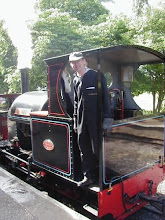
Steve Dentith's gorgeous T Series (101T020/1980) at the Midland Railway Centre, Butterley.

Drool...


Sunday, 13 March 2011

An Irish Survivor

Motor Rail 8970 is a standard 2.5Ton 20/28 model, despatched 23 Jul 1945 to Department of Defence (contracts), Parkgate, Dublin and thence to Baldonnel Aerodrome, Co Dublin. John Curran writes that this engine is still in use to this day by the Department of Defence in the Curragh Military Training Camp in Co Kildare Ireland. It is used to transport targets to the firing ranges. It still retains its original Dorman 2DWD engine.

Saturday, 12 March 2011

Not posted for a while, but to make up for that here are a few photos sent to me of Simplexes around the world. Firstly, the Nykarleby Jernväg, who have a very original 20/28, No 9844 which was ex works 20/4/1953. It was originally supplied through Railway Mine and Plantation Equipment, for supply to Hans Palsbo for H.G.Paloheimo, Osakeyhito, Runimaki, Finland and despatched to Helsingfors (Helsinki, Finland). Many thanks to Keith Burgess in Helsinki for the photo.


Next, we're off to Sabah for an early 3.5 ton Dorman-engined 40S, number 22068, supplied in 1960, again by Railway Mine and Plantation for use in the timber industry (Shing Kee Swan Timber) and was donated to the Sabah Museum in 1991. Many thanks to Ross Ibbotson at the Sabah Museum (via John Browning)


Finally, John Peterson sent these views from FIJI of 100HP Motor Rail 23014. He writes "I recently I visited Fiji and rode behind the above which is now in used on a tourist train. I believe it is 23014 of 1959. The engine has been completely rebuilt into a diesel hydrostatic. There are many U types in service here and I believe they were the inspiration for the conversion. It runs well and very easy to drive as I found as the driver let me take charge and turn it around on the Y for him. The 100hp with its wide bonnet had plenty of space underneath. In fact the driver got inside it to jump start the loco with a spare battery they carry. Disadvantage of the wide body as I found out when I was driving it is you can't judge how far you are from wagons when coupling at the front. The driver had 3 items of essential equipment: spare battery as mentioned, shovel for digging out between flanges on level crossings, and machette for cutting overgrowth on the run, ie. while driving."


John also sent a picture of a second similar loco, the "Puffing Boto", which has had a steam outline bodywork applied.


...and also the following industrial views taken at Penang in the 1980s. They show unidentified 100HP and 32/42HP locos.


Wednesday, 24 March 2010

Sholto's Day Arrives

A fabulous event today at Graham Lee's Statfold Barn Railway for invited guests of Andrew Neale to see the inauguration, complete with formal blessing, of Edward Sholto (Hunslet 996 of 1909) after three years of hard work by Andrew and his dedicated band of volunteers. Engine and owner behaved impeccably and, as Andrew has always promised, we now have a totally original Large Quarry class Hunslet to admire, looking exactly as it would have at the quarry. Sholto was working slate trains in between passenger runs with two of Graham's other engines including "Jack Lane", a brand new Hunslet built in 2005.

Photos show the star of the show, including on the footplate Margaret, the soon to be Mrs Andrew Neale.


Monday, 22 March 2010

Not another Motor Rail at Apedale?

Latest arrival is Motor Rail 8389, delivered ex works from Bedford on 28th March 1947 and supplied to W.G. Turriff Ltd at Leamington Spa as part of an order for three. However, in this case the order was not for the usual 20/28HP Simplex locos, but for 4 ton capacity dumpers, to a design which had much in common with the locomotive, but which was hoped would sustain the company in a world where narrow gauge railways were looking increasingly old fashioned. These early dumpers were fitted with the rugged and reliable Dorman 2DWD engine with standard Simplex clutch and a special gearbox with three forward and one reverse gear in addition to high and low range selection. The Davies detachable tube radiator was also employed, together with the standard Simplex fuel tank. Dumpers were available in both "forward control" and "rear control", the latter being the configuration normally adopted on modern dumpers today. Braking is mechanical, operated by levers and acting on large diameter brake drums on the front wheels.

This particular dumper ended up working at a Stone Quarry at Blakeney-on-Severn, before being withdrawn from service in the 1970s. It first came to the attention of Moseley member Jim Hay in an article in "Classic Plant and Machinery" magazine. When we discovered there was one of these rare machines left, we decided it had to be preserved. A little work has already been done to the hubs, brakes, radiator and fuel tank, but the engine is currently out for checking over and return to operation. Watch this space!


Works photo (c) Alan Keef Ltd, courtesy of Rob Pearman.

Wednesday, 17 March 2010

Genesix Takes Shape

With the crane out and awaiting a delivery for unloading at Apedale, I took the opportunity to fit Motor Rail 7066 with many of the various parts that were painted last week. This included the sandboxes and the gearbox. We also fetched from the stores a suitable bonnet that is still awaiting cleaning and painting, but I couldn't resist putting it on and taking a couple of photographs. It's amazing what a difference these components make. Can't wait until the bonnets are yellow and we can paint on the number 6!

Photos show No 6 now and 37 years ago at Cheadle Moseley.


Monday, 8 March 2010

Springtime for Simplex


My current background project is "Genesix", the rebuild of one of the Moseley Railway Trust's original 20in gauge locomotives from the 1970's school project at Moseley Grammar School. It was bought last year from Alan Keef Ltd as a bare frame. Currently the chassis is completed and the only major part not fitted is the gearbox. This and other sundry parts have been sitting in the workshop since before Christmas painted in undercoat but the weather has been so cold I haven't dared to do the topcoat. Also, I wanted to spray it, as yellow is so horrible to brush paint. Anyway, now we are awaiting the first hints of spring as the yellow daffs start to appear, what better time to paint a bit more of that canary yellow to No. 6? I had forgotten how bright it was!